|
|
|
SOLEMNITY
OF THE MOST HOLY BODY AND BLOOD OF CHRIST
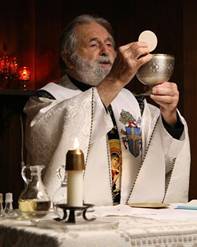
The Catholic faithful celebrates the Solemnity of the Most
Holy Body and Blood of Christ on June 14. This Eucharistic
celebration, which is also called Corpus Christi, is a solemn
commemoration of the institution of that sacrament. It is
also the Church's official act of homage and gratitude to
Christ, who by instituting the Holy Eucharist gave to the
Church her greatest treasure.
The observance of Corpus Christi accents the joyous aspect
of the Last Supper on Holy Thursday when Jesus took bread,
said the blessing, broke it, gave it to them, and said, 'Take
it; this is my body.' Then he took a cup, gave thanks, and
gave it to them, and they all drank from it. He said to them,
'This is my blood of the covenant, which will be shed for
many.'
The Hoy Eucharist is usually symbolized by a chalice, with
a host rising out of it. The chalice is shown with a hexagonal
base, as a rule, symbolizing the Six Attributes of the Deity
(power, wisdom, majesty, mercy, justice and love), and with
a richly wrought stem of gold, studded with precious stones.
The host is shown as the typical circular wafer, upon which
may be imprinted the letters I. N. R. I., from which proceed
rays of light, symbolical of the Real Presence, the substantial
presence of Christ under the species of bread and wine.
With this Eucharistic celebration the sins are purges away,
virtues are increased, and the soul is satiated with an abundance
of every spiritual gift. No other sacrament is so beneficial.
Since it was instituted unto the salvation of all, it is offered
by Holy Church for the living and for the dead, that all may
share in its treasures. May we then share this wonderful sacrament
by a special form of adoration as we commemorate Jesus’
joy in His resurrection.
For more information on the Solemnity of the Most Holy Body
and Blood of Christ, please click on the following links:
•
Novena Honoring the Body and Blood of
Christ
•
Novena for Corpus Christi
•
Adoration Prayer
•
Litany of the Most Blessed Sacrament
•
Chaplet of the Blessed Sacrament
|
|
|
|
| |
|
| SPECIALS |
World
Day of Prayer for Vocations
“The men and women saints that the Church proposes
for the veneration of all the faithful give witness
to the mature fruit of this union between the divine
call and the human response. Let us entrust to their
heavenly intercession our prayer for vocations.”
Pope Benedict XVI delivered this address for the praying
of the midday Regina Caeli to those gathered in St.
Peter's Square, Vatican City on May 3, the fourth Sunday
of Easter.
Below is a copy of the Pope’s message translated
by Zenit:
* * *
Dear brothers and sisters:
I have just concluded, in St. Peter's Basilica, the
Eucharistic celebration in which I consecrated 19 new
priests of the Diocese of Rome. Once again, I have chosen
this Sunday, the fourth of Easter, for this joyous event,
because it is marked by the Gospel of the Good Shepherd
(cf. John 10:1-18) and offers a particularly suitable
context.
Because of this, today is celebrated the World Day of
Prayer for Vocations. In my annual message for this
occasion, I have invited reflection on the theme: "Faith
in the Divine Initiative -- the Human Response."
In fact, trust in the Lord, which continuously calls
to sanctity and, for some in particular, to a special
consecration, is expressed precisely in prayer. As much
personally as in community, we have to pray a lot for
vocations, so that the greatness and the beauty of the
love of God attracts many to follow Christ on the path
of the priesthood and the consecrated life.
It is also necessary to pray as well so that there are
holy spouses, capable of indicating to their children,
above all by example, the horizons to which they should
tend toward with their liberty.
The men and women saints that the Church proposes for
the veneration of all the faithful give witness to the
mature fruit of this union between the divine call and
the human response. Let us entrust to their heavenly
intercession our prayer for vocations.
There is another intention for which I invite you to
pray today: the trip to the Holy Land that I will make,
God willing, next Friday, May 8 through Friday, May
15. Following the footsteps of my venerable predecessors
Paul VI and John Paul II, I will go on pilgrimage to
the principle holy places of our faith.
With my visit, I propose to confirm and encourage the
Christians of the Holy Land, who must daily confront
many difficulties. As a successor of the Apostle Peter,
I will show the closeness and support of the whole body
of the Church. Moreover, I will be a pilgrim of peace,
in the name of the one God, Father of all. I will give
witness to the Catholic Church's commitment in favor
of those who work to practice dialogue and reconciliation,
to arrive to a stable and lasting peace in justice and
mutual respect.
Finally, this trip will necessarily have notable ecumenical
and interreligious significance. Jerusalem is, from
this point of view, the symbolic city par excellence:
There Christ died so as to reunite all of the dispersed
children of God (cf. John 11:52).
Addressing now the Virgin Mary, let us invoke her as
Mother of the Good Shepherd so that she watches over
the new priests of the Diocese of Rome, and so that
in the whole world, numerous and holy vocations of special
consecration to the Kingdom of God may flourish.
[Translation by ZENIT]
[The Holy Father then addressed the faithful in various
languages. In English, he said:]
To all the English-speaking pilgrims and visitors present
for today's Regina Caeli, I extend a warm welcome. I
pray that as you follow the voice of the Good Shepherd,
you will grow ever closer to the Risen Lord and share
his Gospel with all those you encounter. This Friday
I leave for my pilgrimage to the Holy Land, where men
and women first heard the voice of the Good Shepherd.
I ask you all to join me in praying for the afflicted
peoples of that region. In a special way I ask that
you remember the Palestinian people who have endured
great hardship and suffering. May the Lord bless them
and all those who live in the Holy Land with the gifts
of unity and peace. Upon all of you visiting Rome during
this Easter Season, I invoke the abundant blessings
of Almighty God.
© Copyright 2009 - Libreria Editrice Vaticana
|
|
|
|
| |
| |
| TEACHING
CATHOLIC FAITH |
Month of the Holy Family
The month of February is dedicated to the Holy Family
depicts the family of Jesus, Mary, and Joseph as the
model of virtue of all Christian households. This special
devotion began in the 17th century with the institution
of Association of the Holy Family in Montreal, Canada
in 1663, and by the Daughters of the Holy Family in
Paris, France in 1674.
To better understand the life of the Holy Family, it
is best to reflect the home of Nazareth. Since the Holy
Family observed the Jewish law in its perfection, we
can deduce quite accurately what prayers they recited.
The Psalms, of course, were the favorites. Three times
a day Jesus, Mary, and Joseph said the Tephillah, "The
Prayer," consisting of eighteen long invocations
and blessings. Joseph (and later Jesus when He attained
to manhood) was obliged to say the Shema, a sort of
profession of faith in the one true God, twice daily.
A very interesting Jewish custom of prayer that must
have been observed in the house at Nazareth was that
of the Mezuzah, "the doorpost," and the "phylacteries,"
small square calfskin boxes with Scripture texts written
on parchment inside them. Such was the vocal and the
more or less formal prayer which Jesus, Mary, and Joseph
offered in their home at Nazareth. In their hearts,
however, they prayed always. Just as the Heart of Jesus
was constantly united with His divinity, so were the
hearts of Mary and Joseph so closely bound to God that
their every action was a prayer.
The Holy Family models for us what family life should
exemplify. It is a school of virtue for both parents
and children. There we find God, and learn how to connect
with God and with others. The family is where love is
freely given without self-interest. It is where we learn
to love, to pray and to practice the gift of charity.
We should ask ourselves if our own families model that
of the Holy Family. We need to be open to God’s
grace to value the positive and to accept our mistakes
— and to be willing to rectify them. Parenting
is a very challenging responsibility and at times errors
are made despite the best intentions. Recognizing this,
children should trust their parents and never forget
that parents want only what is best for them.
Which leads us to what may be the most important family
virtue — forgiveness. Living so intimately within
the family nucleus naturally gives rise to unpleasant
situations where someone is apt to be offended. St.
Paul knew this when he told us to “bear with and
forgive one another.” The health of our family
may depend on how quickly we learn to forgive without
harboring feelings of resentment. No family can thrive
and grow without constant work. Even the material details
that take time and effort are essential to keeping the
family strong. Everyone has to pull together for the
good of the family — even to the point of putting
ahead of our own needs and ambitions the happiness of
other family members, setting aside our own selfish
desires. It is also important to pray as a family, especially
the holy rosary. Prayer will help us to intensify our
closeness with each other and to learn to forgive.
|
|
|
| |
|
|
| |
| SCRIPTURES |
"People
came to Jesus from every quarter"
Mark 1:40-45
And
a leper came to him beseeching him, and kneeling said
to him, "If you will, you can make me clean."
Moved with pity, he stretched out his hand and touched
him, and said to him, "I will; be clean."
And immediately the leprosy left him, and he was made
clean. And he sternly charged him, and sent him away
at once, and said to him, "See that you say nothing
to any one; but go, show yourself to the priest, and
offer for your cleansing what Moses commanded, for a
proof to the people." But he went out and began
to talk freely about it, and to spread the news, so
that Jesus could no longer openly enter a town, but
was out in the country; and people came to him from
every quarter.
|
|
|
|
|
|
|
|
PowerPoint
Inspiration |
| Download
and Play this Powerpoint |
 |
WHERE
GOD WANTS ME TO BE |
|
 |
CHECK-UP
WITH JESUS |
|
 |
THE
MYSTERIOUS STAIRCASE |
|
|
|
|
| |
| LIVES
OF THE SAINTS |
MAY
25
VENERABLE BEDE
Venerable Bede, the English priest, was famous as
a saint, a priest, a monk, a teacher and a writer of history.

MAY 26
ST. PHILIP NERI
St. Philip Neri was born in Florence, Italy, in 1515. As a
child, his nickname was "Good little Phil."
MAY 27
ST. AUGUSTINE OF CANTERBURY
St. Augustine was the abbot of St. Andrew's monastery
in Rome. Pope St. Gregory the Great chose him and forty other
monks for a mission dear to his heart. .
MAY 28
BLESSED MARGARET POLE
Blessed Margaret was born in 1471. She was the niece
of two English kings, Edward IV and Richard III. Henry VII
arranged her marriage to Sir Reginald Pole. 
MAY 29
ST. MAXIMINIUS
St. Maximinius was a bishop who lived in the fourth
century. It is believed that he was born in Poitiers, France.

MAY 30
ST. JOAN OF ARC
St. Joan was born in 1412. Her hometown was Domremy,
a little village in France. Jacques d'Arc, her father, was
a hard working farmer. 
MAY 31
THE VISITATION OF MARY
Visitation means "visit." The Archangel Gabriel
told the Blessed Virgin Mary that her cousin Elizabeth was
going to have a baby. 
|
|
| |
|
| |
PRIEST
OF THE MONTH |
Father
Thomas Pandippally
Father
Thomas Pandippally is a young portrait of martyr. This 38
year old Cheenkallel-born priest was the sixth of seven children
who gave light on July 12, 1971. Father Pandippally joined
the Carmelite of Mary Immaculate (CMI) Congregation in 1987
and made his first profession on March 19, 1992.
Father Pandippally was actively involved in education and
social services. After taking a bachelor degree in science
from Christ College, Bangalore, Father Pandippally studied
Philosophy at Darsana Philosophate, Wardha and Theology at
Jnana Deepa Vidyapeeth, Poona. After his ordination in 2002
he taught at Jeevandan School at Yellareddy for three years
until he was assigned as the Rector of Aspirants at Nazareth
Bhavanam in Bellampalli. He returned to Yellareddy in April
2007 to become the Director of Jeevadan Centre, Parish Priest
and Correspondent of Jeevadan School.
In his outpouring love, Father Pandippally has watered the
ground with his blood with what appeared to be acts of Hindu
extremists. He was on his way alone to Yellareddy, a village
in the eastern state of Andhra Pradesh, India. He was riding
a motorcycle when he was brutally killed by what appeared
to be Hindu extremists according to reports. His corpse was
found the next morning with 18 stab wounds on the body, broken
arms and legs, and gouged out eyes.
Father Pandippally demise was has stirred believers in India
to cry for more protection by the government amid continued
Christian persecution. More than 2,000 Christians gathered
in Hyderabad to protest the death. A wave of violence against
Christians spread over the neighboring state of Orissa as
they were blamed for the murder of a Hindu political leader
Swami Laxmananada Saraswati.
Christian leaders in Andhra Pradesh were terribly shaken
by Father Pandippally’s incident. They were dismal over
the murder Archbishop Marampudi Joji of Hyderabad, India stated
that the Church in India is shocked and deeply saddened by
this barbarous killing, the result of a growing climate of
intolerance and violence against Christians in this country.
Even though Archbishop Joji was saddened by Father Pandippally’s
demise, he called the priest a martyr. He said: "He sacrificed
his life for the poor and marginalized. But he did not die
in vain, because his body and his blood enrich the Church
in India, particularly the Church in Andhra Pradesh –
the southeastern state where he died."
|
|
| |
| QUOTE
OF THE MONTH |
St. Joseph
“Dear brothers and sisters, our meditation
on the human and spiritual journey of Saint Joseph invites
us to ponder his vocation in all its richness, and to see
him as a constant model for all those who have devoted their
lives to Christ in the priesthood, in the consecrated life
or in the different forms of lay engagement. Joseph was
caught up at every moment by the mystery of the Incarnation.
Not only physically, but in his heart as well, Joseph reveals
to us the secret of a humanity which dwells in the presence
of mystery and is open to that mystery at every moment of
everyday life. In Joseph, faith is not separated from action.
His faith had a decisive effect on his actions. Paradoxically,
it was by acting, by carrying out his responsibilities,
that he stepped aside and left God free to act, placing
no obstacles in his way. Joseph is a "just man"
(Mt 1:19) because his existence is "adjusted"
to the word of God.” Pope Bendict XVI, March 18,
2009
|
|
| |
| PHOTO
OF THE MONTH |
Tour
of the Relics of the Passion
(International Center
for Holy Relics)
www.HolyRelics.org |
|
| |
|
INSPIRATIONAL
STORY OF THE MONTH |
THE
MYSTERIOUS STAIRCASE
City
of Santa Fé, in New Mexico, USA.
A mystery of over 130 years and attracting around 250 thousand
visitors every year. Point of attention : Loretto Chapel
What makes this chapel different from all others is that the
subject of the supposed miracle that took place in it is a
Staircase....
|
|
| |
| REFLECTIONS |
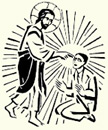
Jesus
Heals the Leper
Do you seek the Lord Jesus with expectant faith? No one who
sought Jesus out was refused his help. Even the untouchables
and the outcasts of Jewish society found help in him. Unlike
the people of Jesus' time who fled at the sight of a leper,
Jesus touched the leper who approached him and he made him
whole and clean. Why was this so remarkable? Lepers were outcasts
of society. Their physical condition was terrible as they
slowly lost their limbs and withered away. They were not only
shunned but regarded as "already dead" even by their
relatives. The Jewish law forbade anyone from touching or
approaching a leper, lest ritual defilement occur. This leper
did something quite remarkable. He approached Jesus confidently
and humbly, expecting that Jesus could and would heal him.
Normally a leper would be stoned or at least warded off if
he tried to come near a rabbi. Jesus not only grants the man
his request, but he demonstrates the personal love, compassion,
and tenderness of God in his physical touch. The medical knowledge
of his day would have regarded such contact as grave risk
for incurring infection. Jesus met the man's misery with compassion
and tender kindness. He communicated the love and mercy of
God in a sign that spoke more eloquently than words.
How do you approach the untouchables and outcasts, and those
you find difficult to love. Do you offer them mercy and help
as Jesus did? The Lord is always ready to show us his mercy
and to free us from whatever makes us unclean.
"Lord Jesus, inflame my heart with your love and make
me clean. May I never cease to tell others of your love and
mercy."
|
|
| |
|
| |
| |
|